
Unit 6: Sure I'll do it.
Learning Outcomes
By the end of this unit, you will be able to:
- Express complaints and respond appropriately with apologies and excuses in everyday situations related to household chores and responsibilities.
- Accurately use two-part verbs (phrasal verbs) and key vocabulary related to household chores while constructing clear and grammatically correct spoken and written responses.
- Make, accept, and refuse requests politely using appropriate structures such as modals (e.g., can, could, would) and expressions like “Would you mind…?”, as well as respond using will.
Unit 6 / Lesson 6A
Level | ESLCO |
Program | ESL Foundations |
Time | Online Lecture: 2 hours Self-study: 5 hours |
Textbook / Digital Pack | Textbook: Pages 36-38 |
6A.1 Dialogue / Role Play
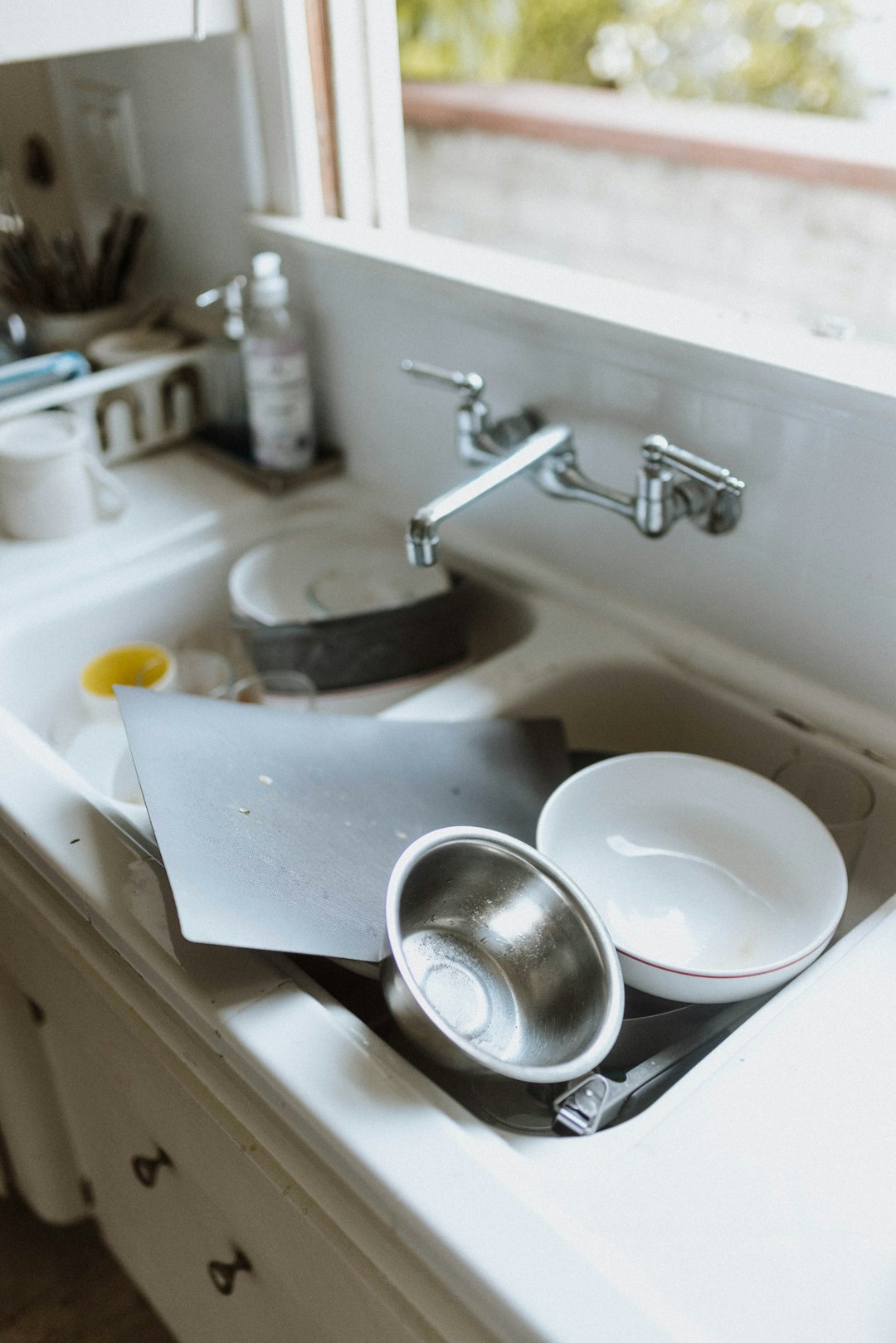
Coral: Hey, the kitchen is really messy. You didn’t clean it up last night.
John: Oh, I’m sorry about that. I had a lot of homework and totally forgot.
Carol: Could you take out the trash now? It’s starting to smell.
John: Sure, I’ll take it out in a minute.
Carol: Also, would you mind washing the dishes later?
John: Actually, I can’t right now—I have to study for a test. But I’ll clean them up after dinner.
Carol: Okay, that’s fine. Just don’t leave them in the sink overnight again.
John: I won’t. Sorry about that—I’ll make sure to do it this time.
6A.2 Vocabulary
Read each word, say it out loud, check the meaning, and practice it every day.

clothes

watch TV

mess

dirty dishes

towels
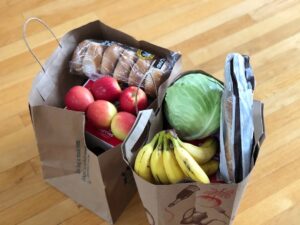
groceries

garbage
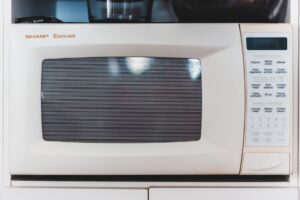
microwave
6A.3 Grammar
Look at each grammar point, read the examples, and try to make your own simple sentences.
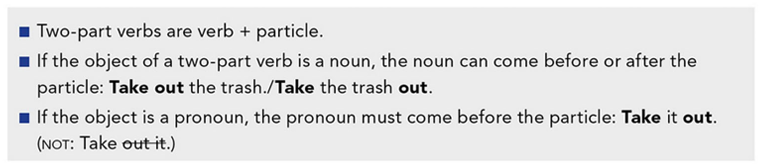
Common Errors
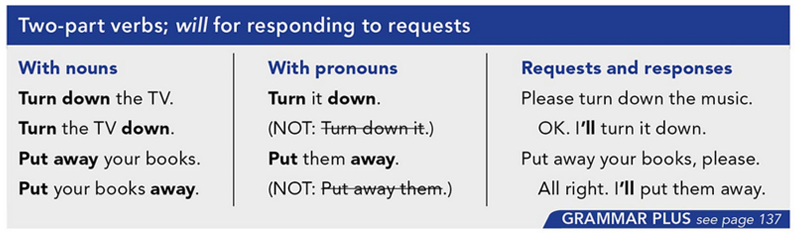
1. Incorrect word order with separable phrasal verbs
Learners often place the object in the wrong position.
 Take out it.
 Take it out.
 Rule: With separable phrasal verbs (take out, clean up), pronouns must go in the middle.
2. Forgetting that some phrasal verbs are inseparable
Students sometimes split verbs that should stay together.
-
Look the word up (correct), but
Look up it (incorrect)
-
Run it into (incorrect if verb is inseparable like run into)
-
Run into it
Rule: Some phrasal verbs cannot be separated, so the object always comes after.
3. Using the wrong particle (preposition/adverb)
Learners mix up particles, which changes the meaning.
-
Take off the trash
-
Take out the trash
Tip: Phrasal verbs must be learned as fixed expressions, not word-by-word.
4. Using “will” incorrectly when responding to requests
Students sometimes use the wrong tense or modal.
-
Yes, I do it.
-
Yes, I can do it. (not wrong, but less natural for immediate response)
-
Yes, I’ll do it.
Rule: Use “will” for immediate decisions or promises in response to requests.
5. Omitting “will” or overusing “going to”
Learners may avoid will or use future forms that don’t fit the situation.
-
I’m going to take it out now (less natural as a spontaneous response)
-
I take it out now
-
I’ll take it out now.
Rule: Use “will” for on-the-spot decisions, especially when agreeing to help.
6A.4 Practice Exercises
Exercise 1: Fill in the Blanks
Exercise 2: Multiple-Choice
6A.5 Textbook
Complete pages 36-38 of your textbook for your homework.
6A.6 Speaking Task 6
 Speaking Assignment Prompt: “Household Problems & Promises”
Instructions:
You are at home and you are unhappy with how your roommate or family member is doing household chores.
Record yourself speaking for 1–2 minutes. In your recording, you should:
- Make at least TWO complaints about household chores
- Make at least TWO polite requests (use Could you…? or Would you mind…?)
- Use at least TWO phrasal verbs (e.g., clean up, take out, put away, pick up)
Example Structure (for students)
- Start with a complaint
- Make a request
- Add another problem and repeat
 Model Starter (optional for students)
"The kitchen is really messy. You didn’t clean it up last night. Could you take out the trash?
When you have finished this lesson, don't forget to Mark lesson complete, below: